Research area · 2013–
Can a digital game serve as a measurement instrument?
Psychology experiments on resource division — the Dictator Game, the Ultimatum Game, the Trust Game, the prisoner's dilemma — usually rely on hypothetical paper scenarios. The line begins with the Virtual Deciders project, on computational models for decisions about resource division (2013–2015), and investigates whether a digital game can be a valid and reliable instrument to measure cooperation and distributive justice, including in children. It is small in volume and includes the two papers in the CV published in psychology and behavior journals.
01 · Games, decision-making and social dilemmas
Contributions
Decisores Virtuais and PsyFun · 2013–2015
The project "Decisores Virtuais: modelos computacionais para tomadas de decisão sobre divisão de recursos" (Virtual Decision-Makers: computational models for decision-making on resource division; FACEPE, 2013–2015), under the responsibility of Giordano Cabral, rebuilt the classic experiments of behavioral economics as digital games. It had a master's scholarship, PIBITI, PIBIC and PIBIC Ensino Médio, with six undergraduate research students, two of them at the Escola Técnica Estadual Cícero Dias: Luiz Delando Santos Moreira Júnior, Eliane Pio, Juliane Travassos Vieira, Bruno Veloso, Décio Vinícius Farias da Silva and Erick Haendel. The dissertation by Samuel Luna Martins, Impacto de ferramentas de entretenimento digitais para experimentos sobre divisão de recursos (UFRPE, 2013, FACEPE), is the first of the line. The PsyFun group, on digital games for cognitive psychology, was born at UFRPE in October 2013.
Lessons Learned · 2017
Lessons learned about the development of digital entertainment tools for experiments on resources distribution, with Samuel Luna Martins, Guilherme Ribeiro Eulálio Cabral, Luiz Delando Santos Moreira Junior and Erick Haendel Costa Fontes Martins (Computers in Human Behavior 70: 523–534, 2017; doi.org/10.1016/j.chb.2017.01.023). It compiles what the team learned when designing digital entertainment tools tailored to scientific experiments, to guide those wishing to build their own. The first journal article in this research area.
Slingshot Challenge and Star Mines · 2017–2022
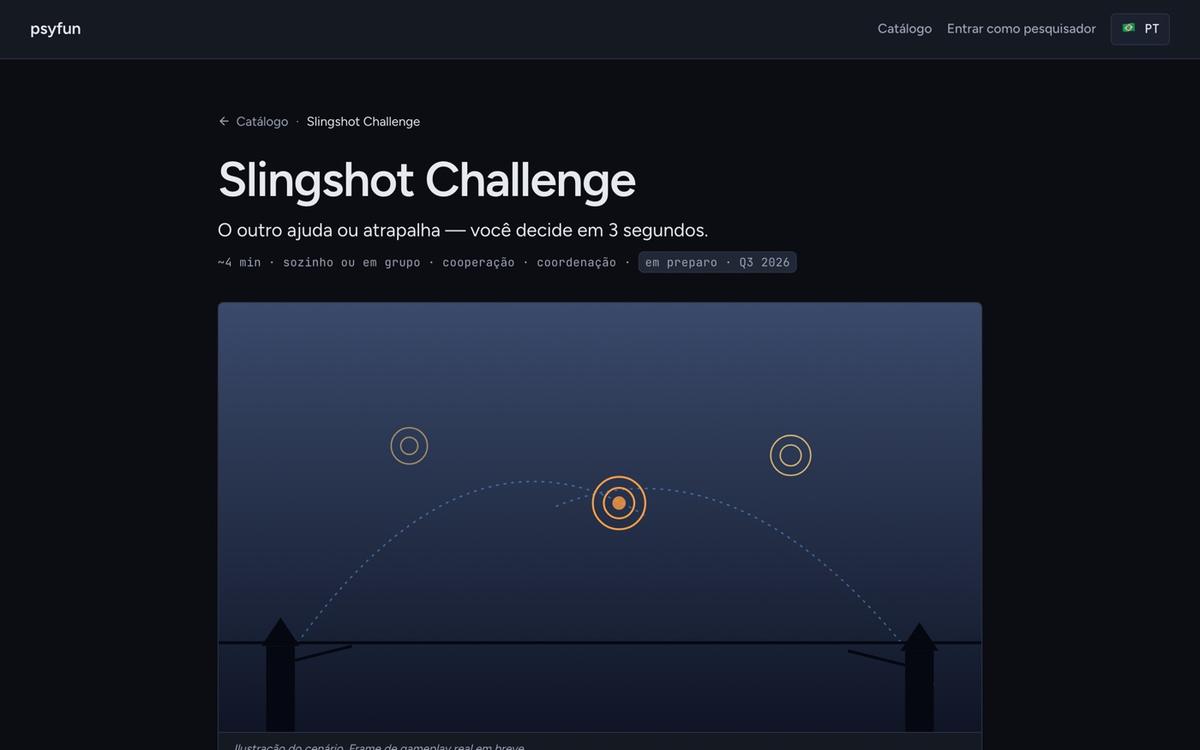
Two digital games with the structure of the prisoner's dilemma, registered as software in 2017 and 2018, with Guilherme Ribeiro Eulálio Cabral and Samuel Martins. The article that validates them, Slingshot Challenge and Star Mines: Two digital games as a prisoner's dilemma to assess cooperation in children, with Guilherme Cabral, Leonardo Rodrigues Sampaio and Raick Bastos Santana (Behavior Research Methods 54: 597–610, 2022, online in 2021; doi.org/10.3758/s13428-021-01661-y), reports two experiments with 162 children aged 6 to 12. They understood the dynamics, were motivated, cooperated more in Star Mines than in Slingshot Challenge, and cooperated conditionally; sex and cooperation in the first round were associated with more cooperation. The conclusion is that the two games are viable, reliable and valid instruments for measuring cooperative behavior in childhood. It is the only article in the CV published in a psychology methods journal.
Further developments · 2021
Correlating Big Five Primary Personality Dimensions with Musical Preferences (SBCM 2021, with Luiz Delando Santos Moreira Júnior and Guilherme Cabral); MySoundtrack: a tool for personalized and adaptive music listening while playing games (SBGames 2021); and Delando's master's thesis on predicting podcast popularity (2021).
The classroom as a laboratory · 2025
In Jogos e Dilemas Sociais (Games and Social Dilemmas) (IF760, 2025.1), with Guilherme Cabral, nine teams made nine games, each with an explicitly stated dilemma, an experimental design, a lesson on ethical limits and data collection within the class itself. See Teaching.
Platforms · 2026
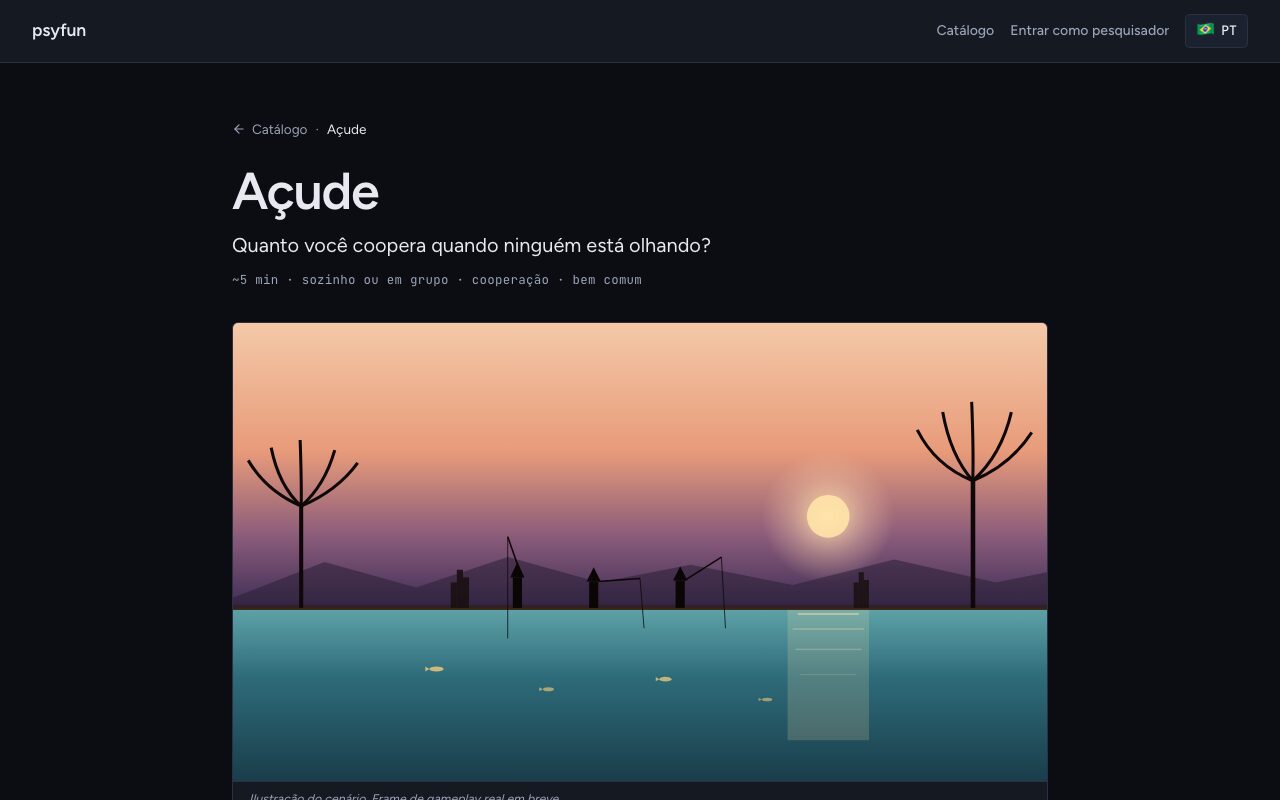
A catalog of 1,202 moddable games for research on social dilemmas, under CC BY 4.0 (github.com/giordanorec/psyfun-catalogo; catalogpsyfun.vercel.app); the PsyFun Platform, which hosts the games and collects data with no account and no ads, with the game Açude, on the use of a common resource (psyfun-platform.vercel.app); and Pixels PsyFun, for building experiments with ten classic games in rooms with an access code (pixels-psyfun.vercel.app).
02 · Games, decision-making and social dilemmas
With whom
Guilherme Ribeiro Eulálio Cabral (UNIVASF); Leonardo Rodrigues Sampaio and Raick Bastos Santana; Samuel Luna Martins; Luiz Delando Santos Moreira Júnior; Erick Haendel Costa Fontes Martins.
Continues in: PsyFun, a collaboration between CIn/UFPE and UNIVASF.