Tendências em Mídia e Interação
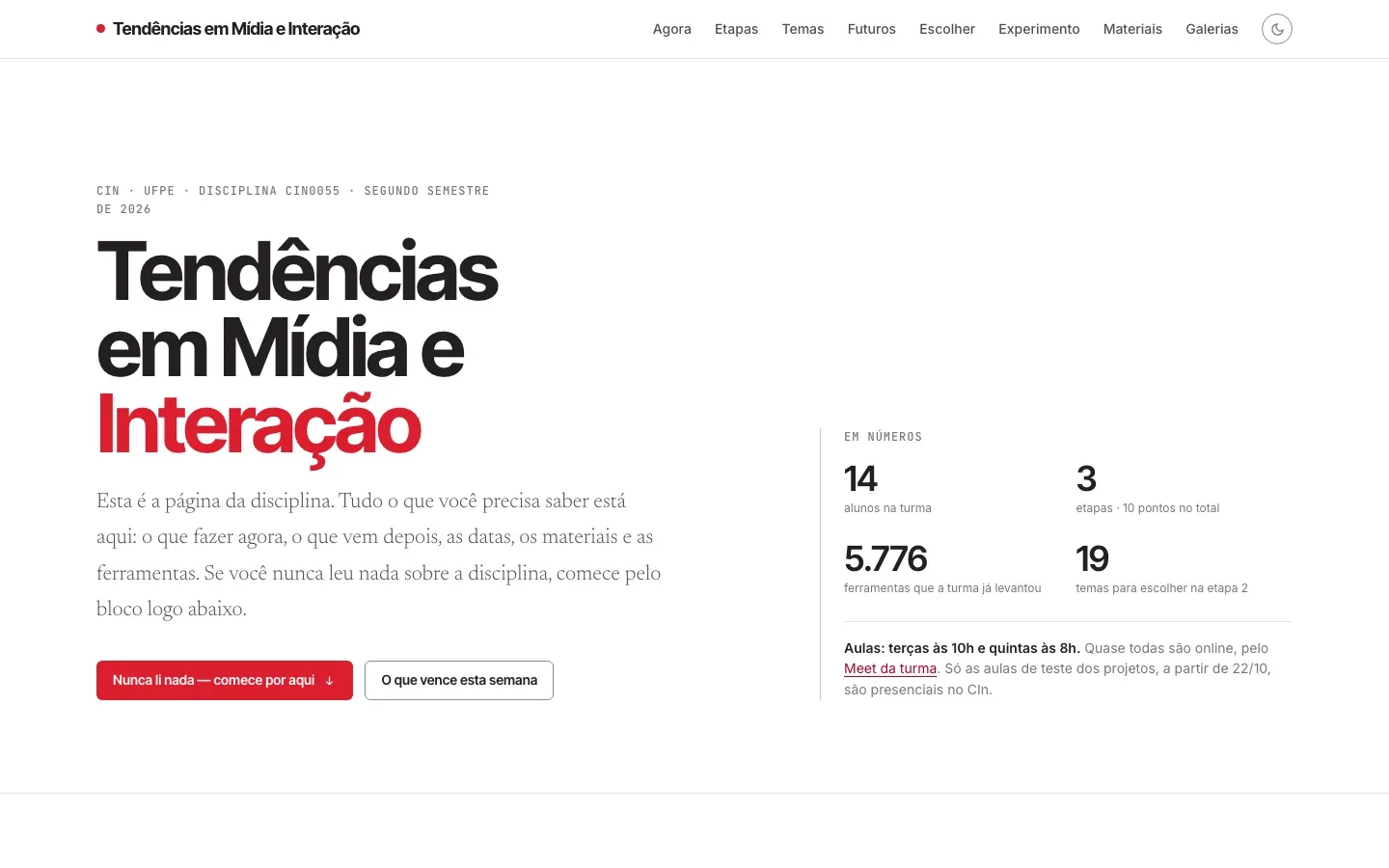
Each student scans tools with the help of AI, builds their own futurization skill for an emerging topic, and brings an experiment to the class. 2026.2 edition site.
Teaching · 2005 → 2026
Giordano Cabral has taught at CIn/UFPE since 2015.1, in every semester except 2023.2 and 2024.1, the period of his postdoctoral fellowship at Stanford. Before that, he taught at UFRPE (2010–2014), in the undergraduate program in Information Systems and the graduate program in Applied Informatics; at the Faculdades Integradas Barros Melo (2009–2010), in the undergraduate program in Phonographic Production; and, in 2005, at the Université Pierre et Marie Curie (Paris 6). Each course has its own page, with what the classes produced.
01 · Teaching
Each student scans tools with the help of AI, builds their own futurization skill for an emerging topic, and brings an experiment to the class. 2026.2 edition site.
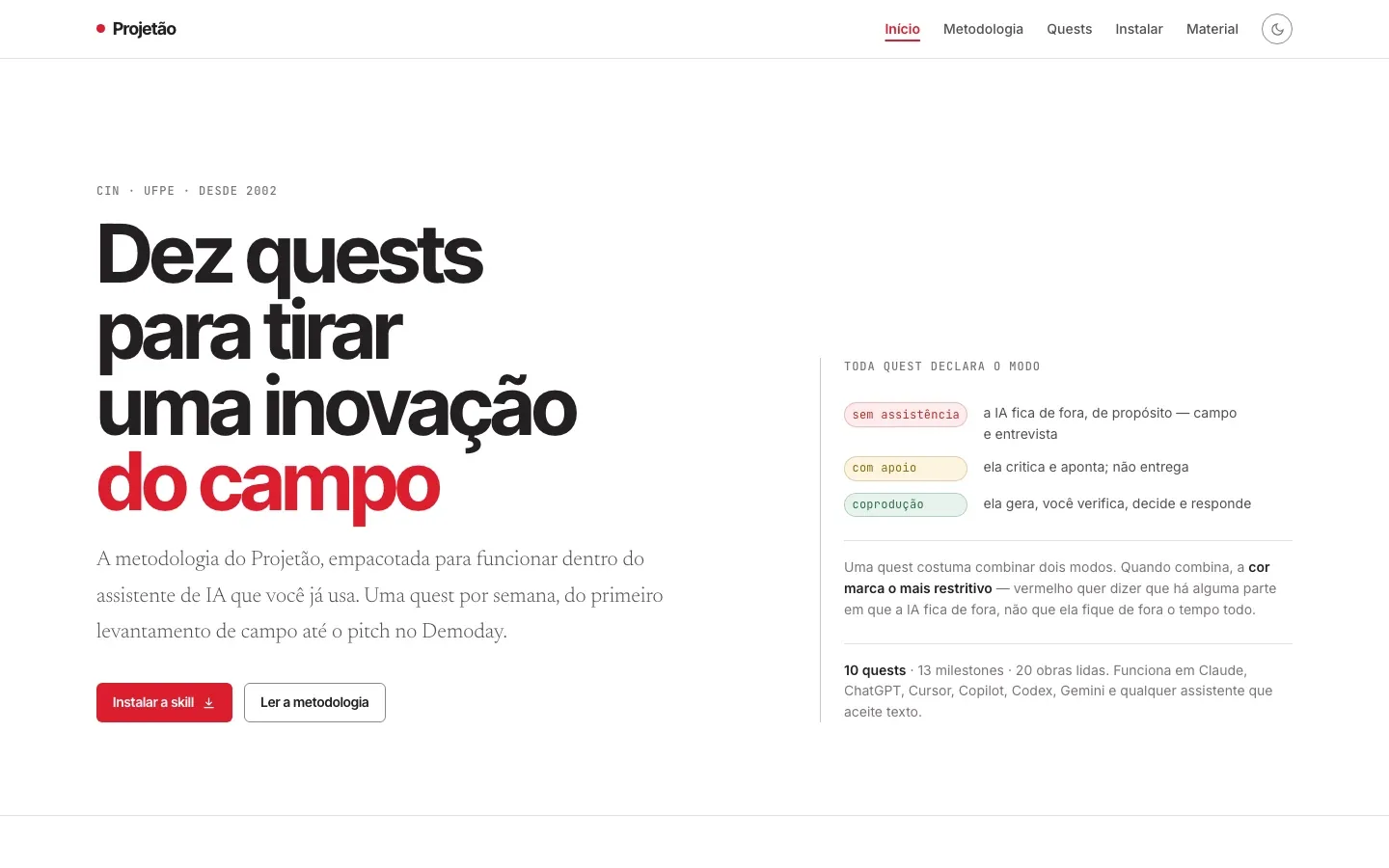
Teams build a digital product in fifteen weeks, quest by quest, up to the Demoday; since 2026, with the quests packaged for use with AI assistants at projetao-ufpe.vercel.app.
Design of digital products in four stages, with content on engagement and gamification.
02 · Teaching
| Course | Where | Code | Semesters | Classes |
|---|---|---|---|---|
 Innovation Innovation | ||||
| Information Systems Project (Projetão) | CIn/UFPE | IF985 | 2016.1 → 2026.2, excluding 2023.2 and 2024.1 | 21 |
| Creative Economy | CAC and CIn/UFPE | 2017.1, 2018.2 | 2 | |
| Innovation in ICT | UFRPE | 2013.1 | 1 | |
 Artificial intelligence Artificial intelligence | ||||
| Criatividade Computacional | CIn/UFPE | IF760 · IF767 · IF866 | 2020.2, 2020.3, 2021.1, 2021.2, 2022.2, 2023.1 (with Filipe Calegário) | 6 |
| Intelligent Systems · Intelligent Systems Programming | UFRPE | 2012.2 | 2 | |
| Computational Intelligence · Hybrid Intelligent Systems · Applied Methods in Computational Intelligence | UFRPE, graduate program (PPGIA) | 2011.2, 2012.1, 2012.2 | 4 | |
| Introduction to Artificial Intelligence | Université Pierre et Marie Curie (Paris 6) | 2005 | 1 | |
 Multimedia Multimedia | ||||
| Tendências em Mídia e Interação | CIn/UFPE | CIN0055 | 2026.1, 2026.2 | 2 |
| Introdução à Multimídia | CIn/UFPE | IF687 · IF849 | 2015.1 → 2025.2, excluding 2023.2 and 2024.1; two classes in 2020.3 | 21 |
| Jogos e Dilemas Sociais (Games and Social Dilemmas) | CIn/UFPE | IF760 | 2025.1 (with Guilherme Cabral) | 1 |
| Jogos Digitais | CIn/UFPE, undergraduate and graduate | IF793 · IN1184 · CIN0054 | 2015.2, 2016.2, 2017.2, 2018.1, 2018.2 (with Geber Ramalho); 2020.2 | 6 |
| Computação Musical | CIn/UFPE, undergraduate and graduate | IF754 · IF760 · IN1132 | 2015.1, 2016.1, 2016.2, 2017.2, 2018.1, 2019.1, 2020.1, 2020.3, 2021.1, 2021.2, 2022.1, 2025.2 | 12 |
| Music Technology | Graduate Program in Music (PPGM), UFPE | 2018.1 | 1 | |
| Music Hardware and Software | Faculdades Integradas Barros Melo (AESO) | 2009.1, 2009.2, 2010.1 | 3 | |
 Software development Software development | ||||
| Concepção de Artefatos Digitais | CIn/UFPE | CIN0131 | 2024.2, 2025.1, 2026.1 (with Alex Sandro Gomes) | 3 |
| Programming Lab · Object-Oriented Modeling and Programming | UFRPE | 2010.2 → 2013.2 | 8 | |
| Software Process and Development | UFRPE | 2013.2 | 1 | |
 Education Education | ||||
| ProfLab: Game Design Thinking for educators | teacher training | 2016 → 2019 | ||
 Business management Business management | ||||
| Estruturas Organizacionais e Planejamento Estratégico (Organizational Structures and Strategic Planning) | CIn/UFPE, Professional Master's | 2015 (2014 cohort), 2019.1 | 2 | |
| Sistemas de Gestão Empresarial | CIn/UFPE | 2015.2 | 1 | |
03 · Teaching
At UFPE. CM = Computação Musical · IM / TMI = Introdução à Multimídia and Tendências em Mídia e Interação · PJ = Projetão · EC = Creative Economy · JD = Jogos Digitais · CC = Criatividade Computacional · CAD = Concepção de Artefatos Digitais · JDS = Games and Social Dilemmas · SGE = Sistemas de Gestão Empresarial · MP = Professional Master's · TM = Music Technology (PPGM).
| Semester | CM | IM / TMI | PJ | EC | JD | CC | CAD | JDS | SGE | MP | TM |
|---|---|---|---|---|---|---|---|---|---|---|---|
| 2015.1 | ● | ● | |||||||||
| 2015.2 | ● | ● | ● | ● | |||||||
| 2016.1 | ● | ● | ● | ||||||||
| 2016.2 | ● | ● | ● | ● | |||||||
| 2017.1 | ● | ● | ● | ||||||||
| 2017.2 | ● | ● | ● | ● | |||||||
| 2018.1 | ● | ● | ● | ● | ● | ||||||
| 2018.2 | ● | ● | ● | ● | |||||||
| 2019.1 | ● | ● | ● | ● | |||||||
| 2019.2 | ● | ● | |||||||||
| 2020.1 | ● | ● | ● | ||||||||
| 2020.2 | ● | ● | ● | ● | |||||||
| 2020.3 | ● | ●● | ● | ||||||||
| 2021.1 | ● | ● | ● | ● | |||||||
| 2021.2 | ● | ● | ● | ● | |||||||
| 2022.1 | ● | ● | ● | ||||||||
| 2022.2 | ● | ● | ● | ||||||||
| 2023.1 | ● | ● | ● | ||||||||
| 2023.2 | |||||||||||
| 2024.1 | |||||||||||
| 2024.2 | ● | ● | ● | ||||||||
| 2025.1 | ● | ● | ● | ● | |||||||
| 2025.2 | ● | ● | ● | ||||||||
| 2026.1 | ● TMI | ● | ● | ||||||||
| 2026.2 | ● TMI | ● |
The two blank semesters are the postdoctoral fellowship at the Lemann Center, at Stanford University. In 2020.1 the classes were interrupted in March by the pandemic and resumed in 2021; 2020.3 is the remote supplementary semester.
Two theses and fourteen dissertations as principal advisor; one PhD and ten dissertations as co-advisor; eight undergraduate capstone projects, ten undergraduate research projects, and one postdoctoral fellowship.
04 · Teaching
Games, instruments, digital products, prototypes and AI experiments made in the courses from 2015 to 2026, with the names of those who made them.

Mikaell Miguel da Silva
A platform connecting women traveling alone to a network of "godmothers" — verified and trained residents of their destination — for support, companionship and safety during the trip, with services accessed through credits (local tips, support, airport reception, in-person accompaniment).
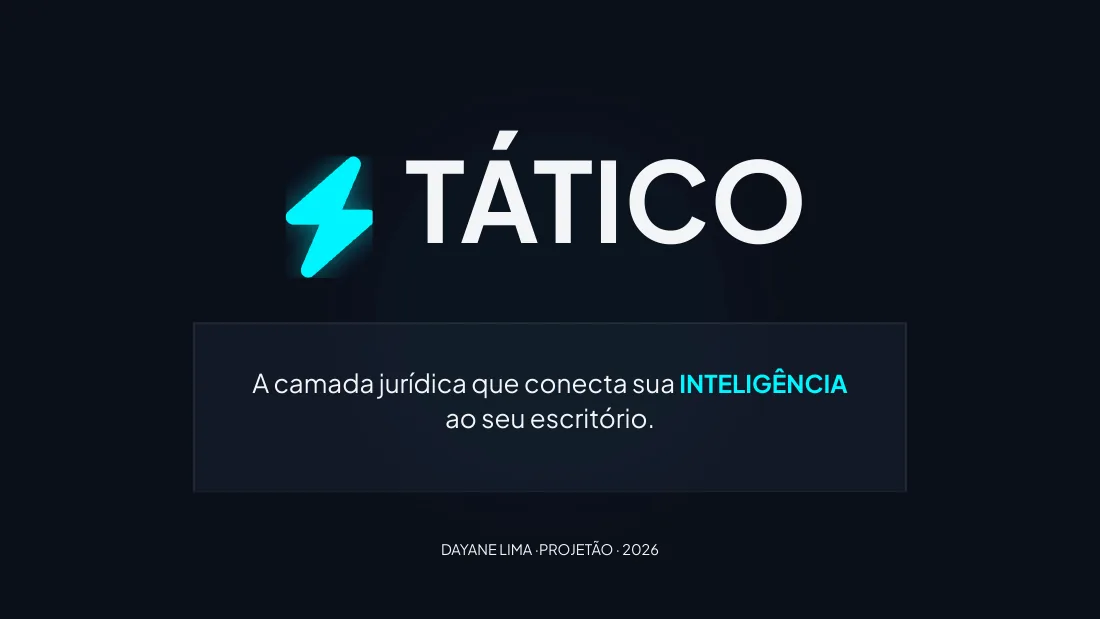
Dayane Lima
An operational management system for small (boutique) law firms, organized around the client as the unit — rather than the court case — and designed as a context layer for the use of AI assistants in the firm.
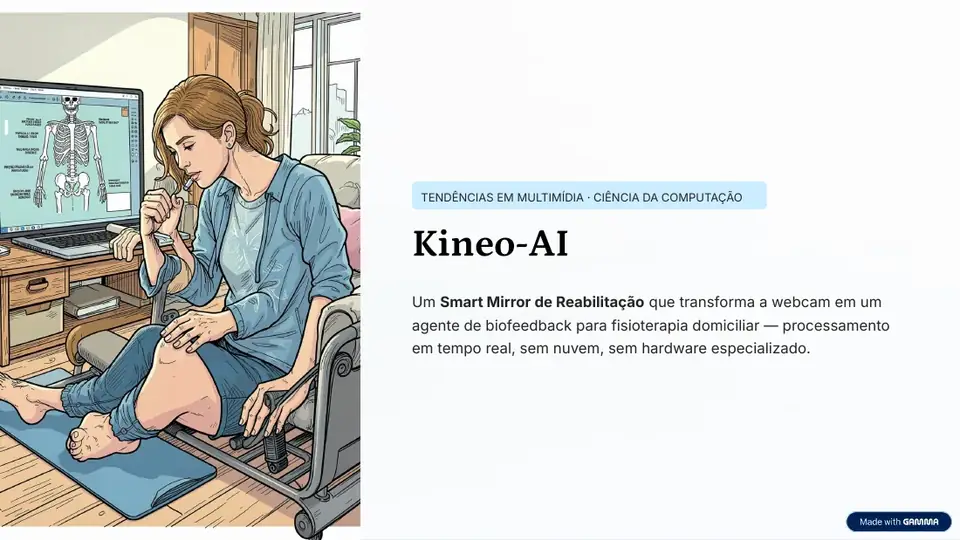
Murilo Ventura, Natan Frederico, Vinícius Rodrigues
A smart rehabilitation mirror: the webcam tracks the patient's posture in real time (MediaPipe Pose, running on the device itself), calculates joint angles, and corrects home physical therapy exercises with visual and voice feedback.

A survival game built as a test environment for LLM-controlled agents, each with a personality (cooperative, selfish, aggressive, strategic), to observe when an agent acts selfishly or altruistically depending on the prompt and environment.
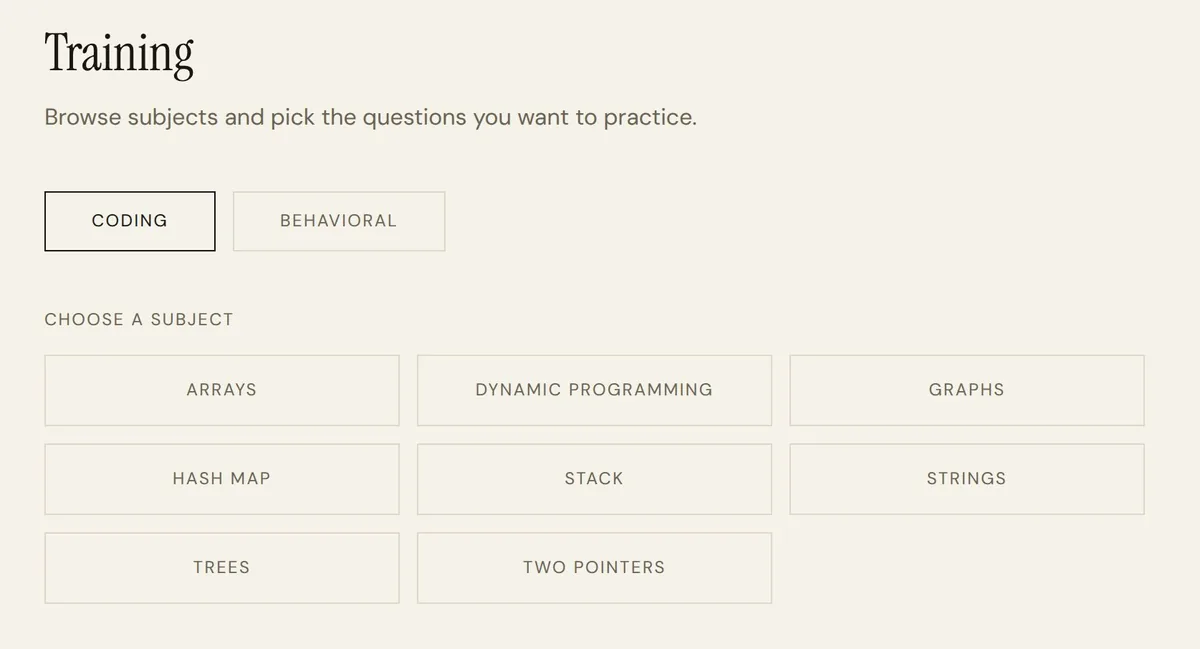
Anne Pereira Collier de Mendonça, Antonio Henrique Souza Lima, João Luís Gomes Agra, João Victor Ribeiro Costa de Omena, Maria Clara Albuquerque Moura, Renato Moreira Serrano de Andrade
A technical and behavioral interview simulator: audio responses are transcribed with Whisper and assessed by a language model using the STAR framework, alongside programming problems organized by difficulty.

An application in which users record their day in audio — accounts, meetings, moments — and AI automatically generates a summary in the form of insights.
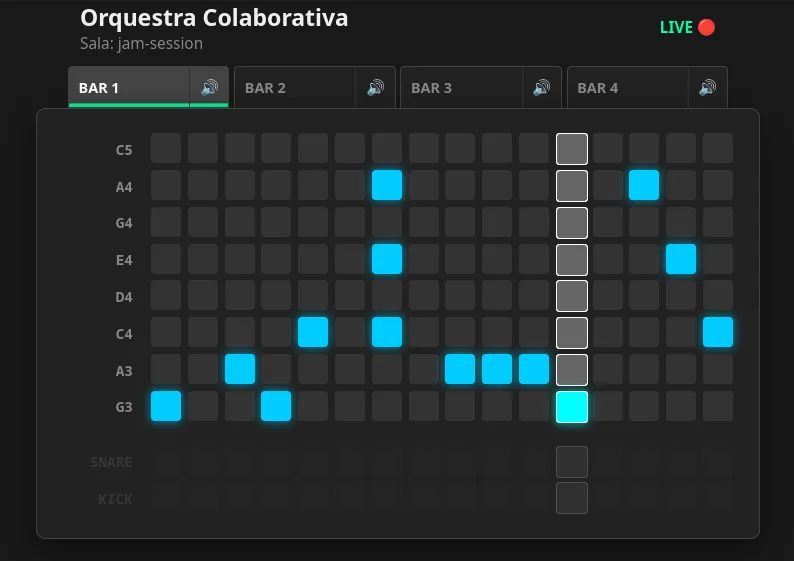
Breno Silva, Murilo Barbosa, Tiago Menezes, Victoria Luquet
A grid-based music sequencer with 64 steps across four bars, in which multiple users compose simultaneously in the same room, switching between piano, synthesizer, and guitar; synchronized via WebSockets.
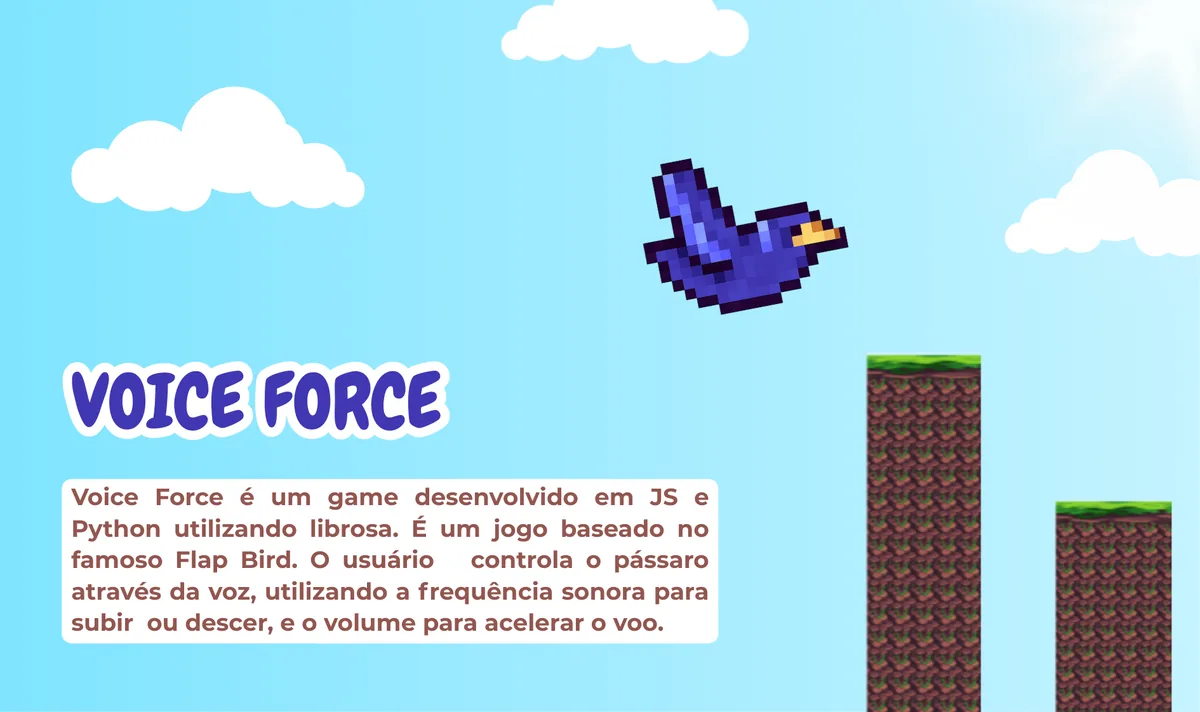
Allan Soares Vasconcelos, Álvaro Gabriel C. Lima, Peterson Jesus Feitosa de Melo, Vinicius Sales Oliveira
A game inspired by Flappy Bird, controlled entirely by voice: sound frequency makes the bird rise or fall, and volume speeds up its flight; built in JavaScript and Python with librosa.
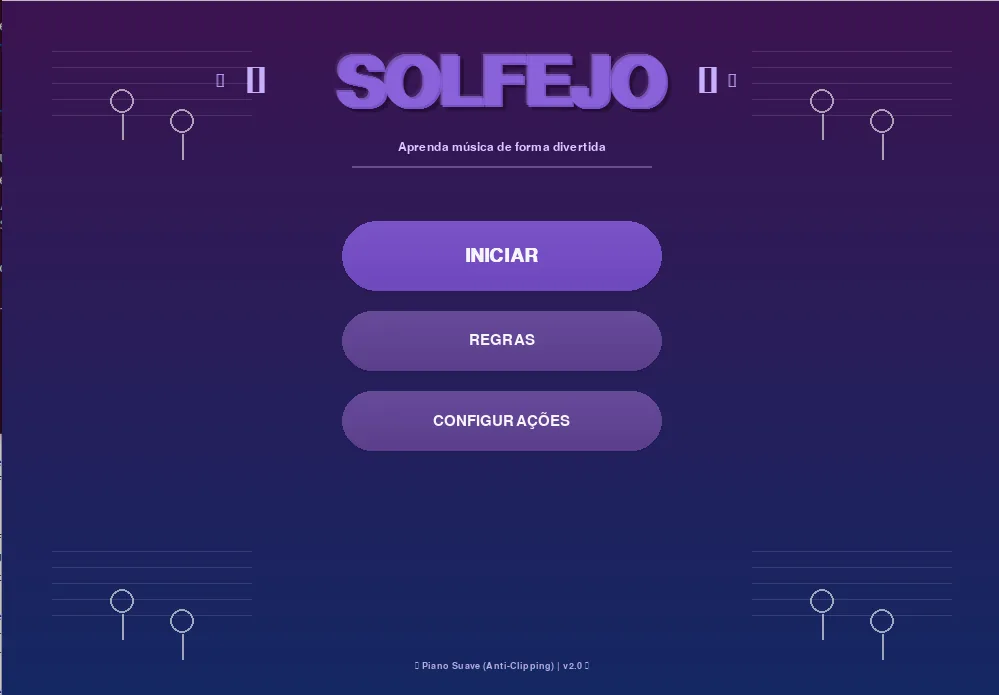
Daniel Nascimento, Henrique Melo, Luis Eduardo Freitas, Mader Gabriel, Pedro Calheiros, Pedro Lucas
An educational game with real-time pitch detection: the player listens to familiar melodies and must sing the requested notes to advance, practicing solfège and ear training.
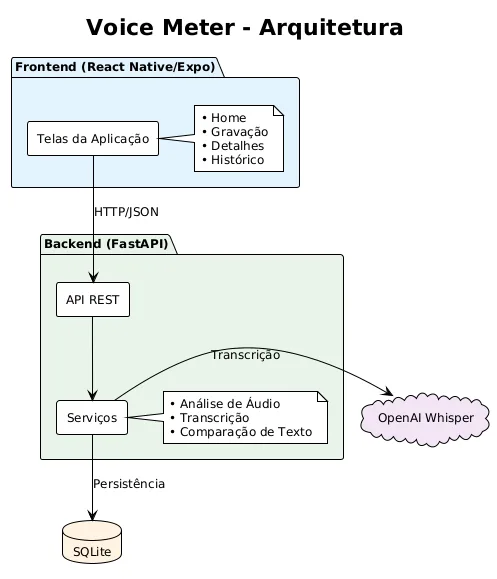
Humberto Lima, David Ubaldo, Natan Lima, João Oliveira, Tarcisio Rickson, Vinicius Rodrigues, Danilo Lapa
Public speaking practice app: records speech, transcribes it with Whisper, analyzes the audio and compares it with the intended text; React Native on the phone and FastAPI on the server.
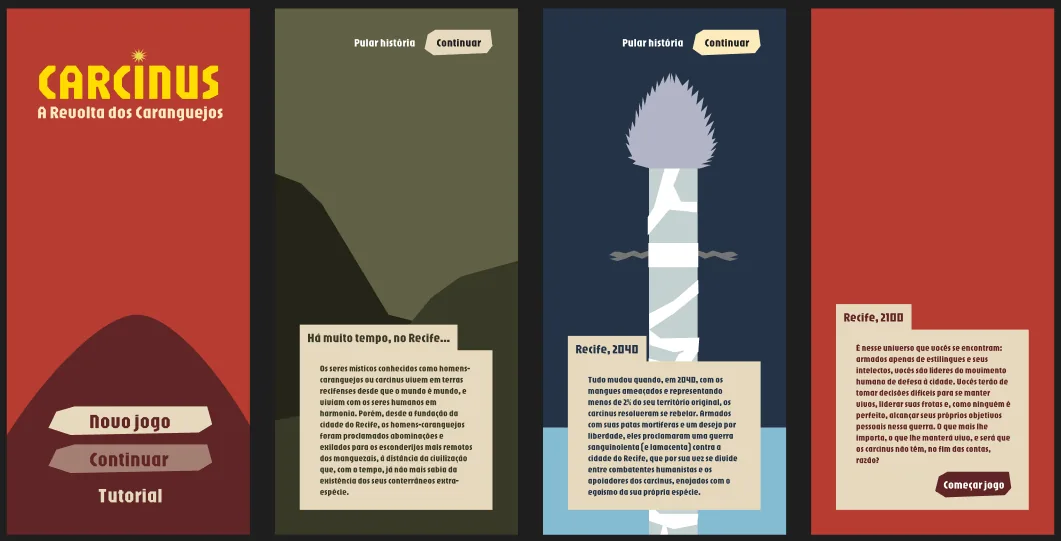
A multiplayer Android game inspired by Reigns, set in a dystopian Recife in 2040 where crab-men rebel: the group votes on event cards that affect four collective stats, while each player pursues personal objectives — the tragedy of the commons in game form.
Beatriz de Araujo Andrade, Erlan Lira Soares Junior, Guilherme Maciel de Melo, Pedro Arthur Santana Patriota, Pedro Augusto de Almada Lobo Fonseca
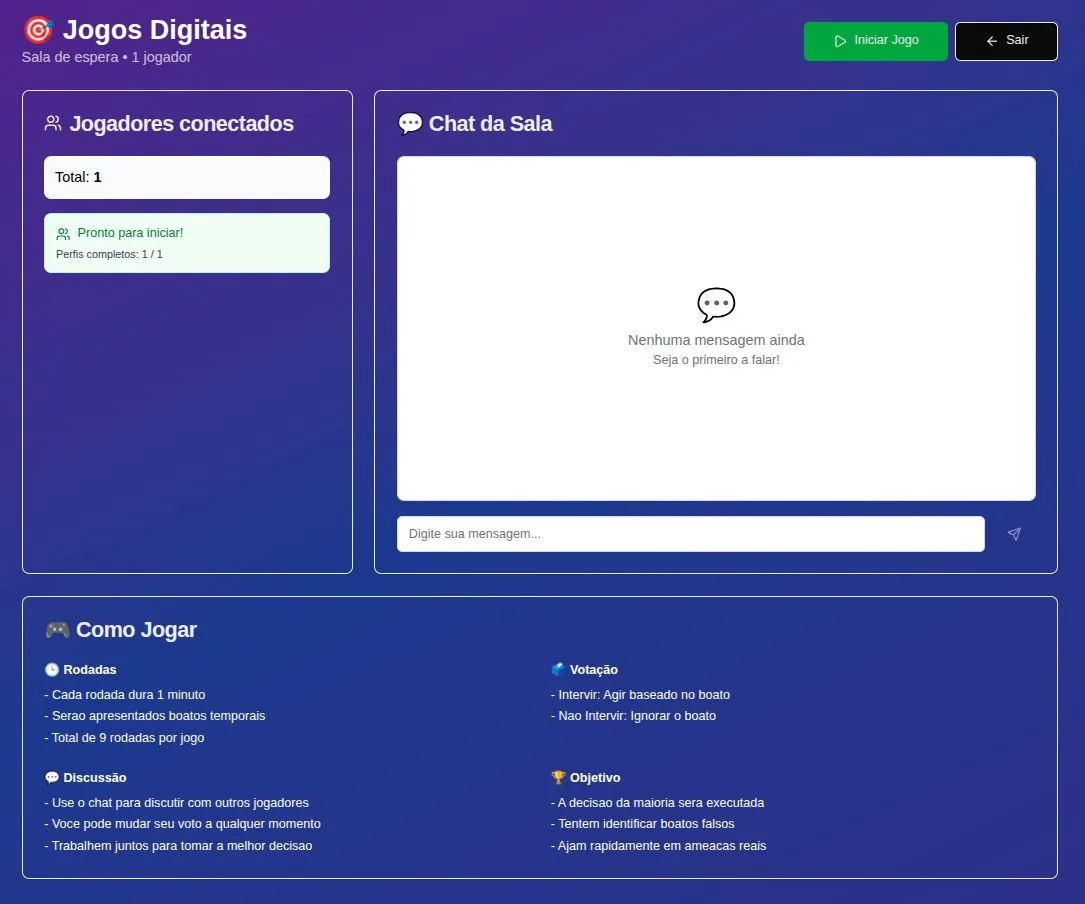
A multiplayer web game (2 to 8 players) about herd behavior and misinformation: "time navigators" vote, amid true and false rumors, on whether to intervene in past events to prevent a devastated future.
Beatriz Barros, Bernardo Melo, Letícia Pedrosa, Rafael Teles
A coalition government in a fictional country in crisis: each group decision affects four indicators (stability, security, economy, freedom), and the experiment observes how communication among decision-makers changes consensus and alignment; a web prototype built with Django.
Gabriel Kristian Queiroz de Souza Jales, Iris Soares, Josue Fidelis de Oliveira Neto, Luana Porciuncula Barreto, Melissa Falcao
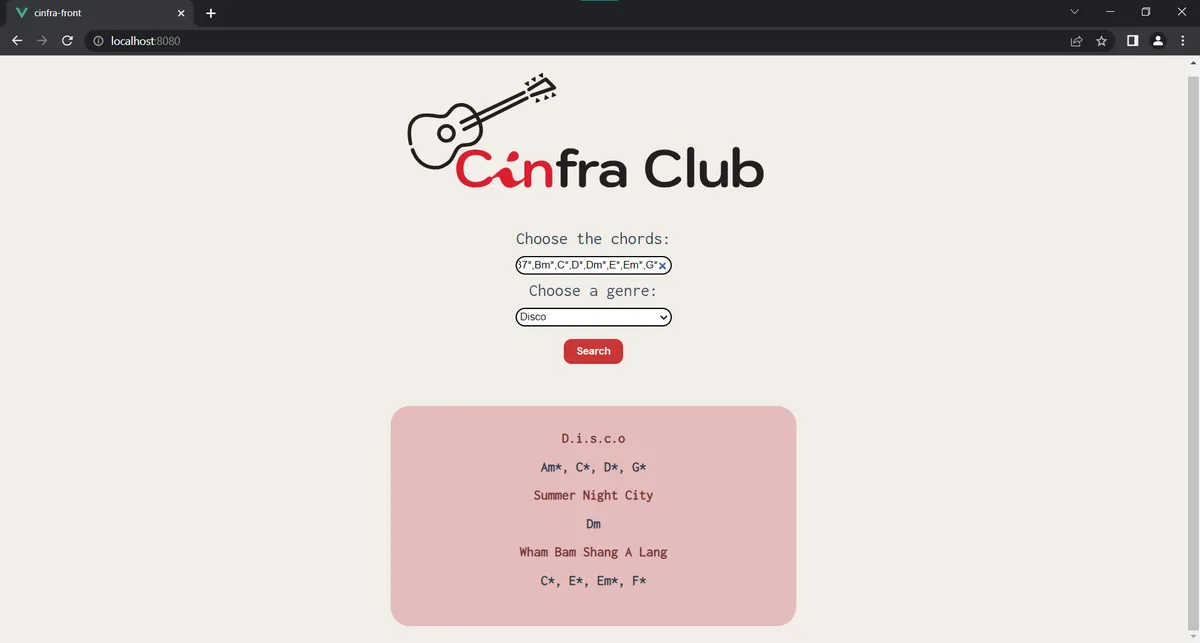
Application that finds songs on Cifra Club by the chords used to play them, with a database built by scraping the pages and a genre search.
Frequently asked questions
60 classes at CIn/UFPE since 2015, in 11 courses. Before that, he taught at UFRPE (2010–2014), in the undergraduate program in Information Systems and the graduate program in Applied Informatics; at Faculdades Integradas Barros Melo (2009–2010); and, in 2005, at Université Pierre et Marie Curie (Paris 6).
Tendências em Mídia e Interação (Trends in Media and Interaction, CIN0055), Projeto de Sistemas de Informação (Projetão, IF985) and Concepção de Artefatos Digitais (Design of Digital Artifacts, CIN0131), the latter with Alex Sandro Gomes. Each has its own page, reachable from Teaching.
Tendências em Mídia e Interação (CIN0055), starting in 2026, with the approach adapted to the use of AI agents. Introdução à Multimídia (IF687) was offered from 2015.1 to 2025.2 and has its own page.